Venice, FL, July 06, 2026 (GLOBE NEWSWIRE) -- Plumbing Detectives LLC announced today the expansion of its polybutylene pipe inspection services for homeowners throughout Sarasota and Charlotte Counties in response to growing insurance coverage challenges associated with aging plumbing systems. The expanded service is designed to help homeowners identify the presence of polybutylene piping, a material commonly installed in homes built between 1978 and 1995, and provide documented assessments and replacement recommendations that may assist with insurance underwriting, renewal requirements, and property transactions.
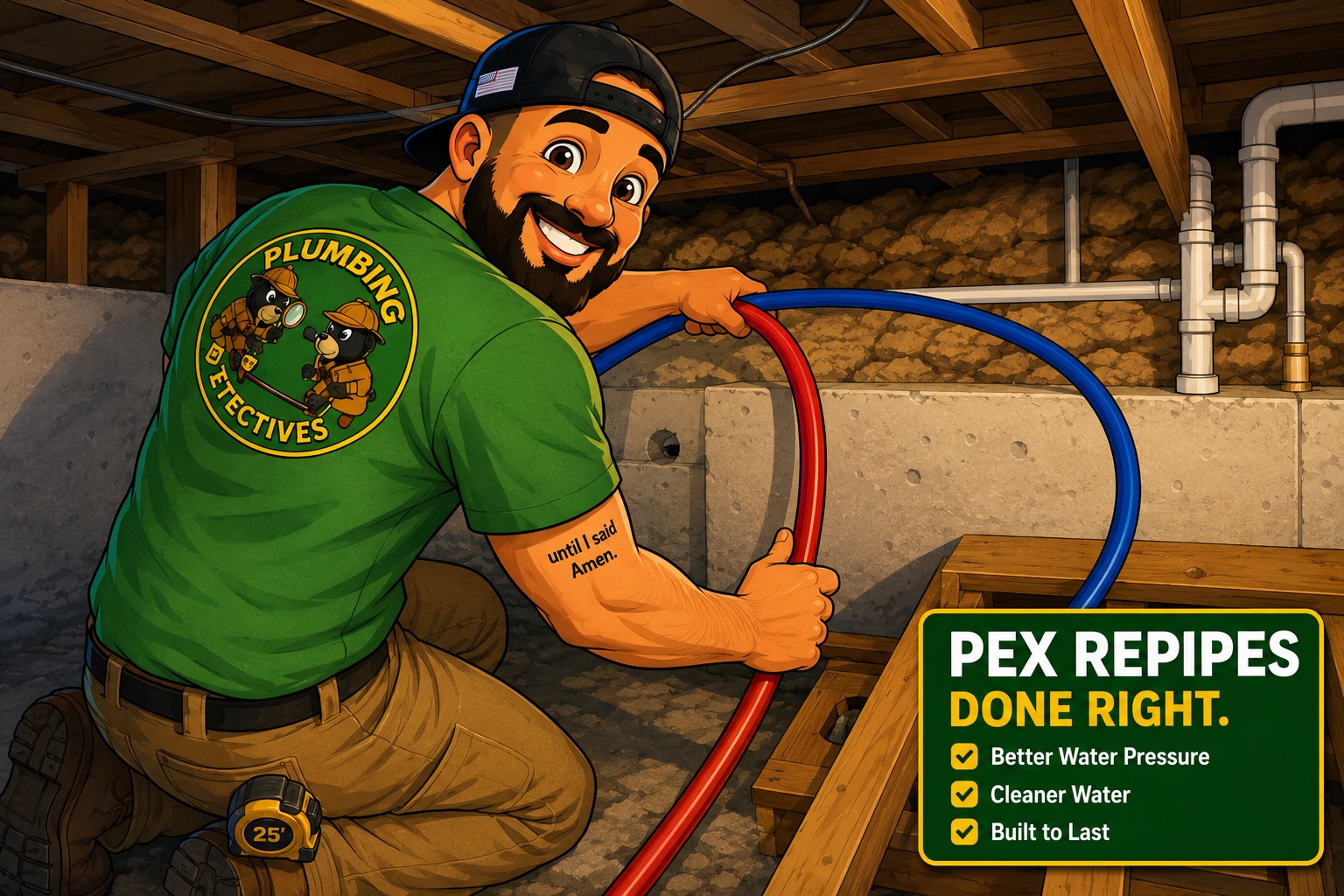
Plumbing Detectives LLC technician installing PEX repiping in a Southwest Florida home - the modern solution for homes with failing polybutylene pipe.
A plumbing material that was quietly phased out of American construction three decades ago is now at the center of one of Florida's most pressing — and least understood — homeowner crises. Polybutylene pipe, a gray plastic plumbing material installed in millions of American homes between 1978 and 1995, was the subject of a landmark $1.14 billion class action settlement in the mid-1990s after Shell Oil Company's acetal fittings were found to react chemically with chlorine and oxidants commonly found in municipal water supplies — causing the pipe to become brittle, crack, and fail from the inside out. But the settlement is long closed, the awareness campaigns have faded, and hundreds of thousands of Florida homes are still running on it.
Now, as Florida's already-strained insurance market continues to tighten, polybutylene pipe is resurfacing as a financial time bomb for homeowners who have no idea it's hidden behind their walls.
"This is exactly the kind of problem people don't see coming," said Mike Reynolds, owner of Plumbing Detectives LLC, a licensed plumbing contractor serving Venice, Sarasota, and the surrounding Southwest Florida communities. "A homeowner calls us for something completely unrelated — a slow drain, a water heater swap — and we open a wall or look under a cabinet and there it is: gray polybutylene pipe, stamped PB, that's been sitting there since 1987. And now we have to have that conversation about what it means for their insurance."
A Material That Was Supposed to Be Gone
Polybutylene pipe — often identified by its gray, blue, or black color and the stamped markings "PB2110" along the pipe's surface — was manufactured and distributed primarily by Shell Chemical Company and installed across the United States during a period of rapid residential construction. At its peak, industry estimates placed the number of affected homes at between six and ten million nationwide, representing approximately one in five homes constructed during that period. Florida, as a core "Sun Belt" state with explosive residential growth throughout the 1980s and early 1990s, holds a disproportionate share of that inventory.
The fundamental problem with polybutylene is not a manufacturing defect in the traditional sense — it is a chemical incompatibility. When polybutylene pipe and its associated acetal plastic fittings are exposed to chlorine and other disinfectants present in virtually all municipal water systems, the material begins to oxidize and degrade at a microscopic level. Over time, micro-fractures form throughout the pipe wall and fittings. There is no visual warning sign. No discoloration. No detectable change in water pressure. Then, without any prior indication, a joint fails — typically at a fitting — and the resulting water intrusion can cause thousands to tens of thousands of dollars in structural damage before it is discovered.
This pattern of failure contributed to the 1992 filing of Cox v. Shell Oil Company, the class action lawsuit that ultimately resulted in a $1.14 billion settlement — one of the largest plumbing-related class action settlements in American legal history. More than 320,000 homes received complete replumbing at no cost to the homeowner through the settlement fund. But the fund has long since closed. Homes that were missed, homes whose owners were unaware, and homes that changed hands in the decades since are now entirely on their own.
Florida's Insurance Crisis Is Changing the Stakes
For decades, polybutylene pipe was largely a background concern — something home inspectors noted and buyers occasionally negotiated over. That dynamic has shifted sharply in recent years as Florida's homeowners insurance market has undergone a historic contraction.
Multiple private insurers have exited the Florida market entirely since 2022. Those that remain have become significantly more restrictive in what they will underwrite, with aging or substandard plumbing systems among the most scrutinized line items on four-point inspection reports — the property condition assessments that Florida insurers require for homes typically older than 20 to 30 years before issuing or renewing coverage.
Citizens Property Insurance Corporation, Florida's state-backed insurer of last resort, has formalized its position: it will not insure any property with polybutylene plumbing. Private carriers have followed. Reports of policy cancellation notices specifically citing the presence of polybutylene pipe have increased substantially, leaving homeowners who discover the material during a routine renewal inspection facing a narrow window to repipe before coverage lapses entirely.
"We've had customers come to us in a genuine panic," Reynolds said. "Their insurance company sent them a 30-day notice after a four-point inspection found poly pipe, and they're calling us trying to understand what it is, how serious it is, and how fast we can fix it. The answer to the last question is: as fast as you need us. But we always tell them — the homeowners who find out on their terms, before an insurance deadline or a pipe failure, are in a much better position than the ones who find out the hard way."
The Plumbing Detectives Approach: Find the Problem Before the Problem Finds You
Plumbing Detectives LLC was built on a straightforward principle: most plumbing disasters that cost homeowners significant money are not random acts of fate. They are the predictable result of conditions that existed — often for years — before anyone looked closely enough to find them. That philosophy drives the company's approach to every service call, from routine maintenance to full system diagnostics.
"The name isn't just a brand," Reynolds said. "It's the way we work. When we're in a home, we're not just doing the job we were called for — we're observing. We're looking at what else is going on. We've found slab leaks during water heater replacements. We've found failing shutoff valves during toilet installs. And yes, we've found polybutylene pipe during what should have been a simple drain call. That's the job."
For homeowners in Sarasota and Charlotte Counties — particularly those in homes constructed between 1978 and 1995 — the company recommends a proactive plumbing inspection specifically to identify whether polybutylene pipe is present in the home's supply lines. The inspection process involves visual examination of all accessible plumbing, including under sinks, in utility closets, at water heater connections, and at any accessible wall penetrations. In many cases, a determination can be made in a single visit.
When polybutylene pipe is confirmed, Plumbing Detectives provides homeowners with a documented assessment they can present to their insurance carrier, along with a complete replumbing estimate using modern PEX piping — the current industry standard for residential supply lines, which does not share polybutylene's chemical vulnerability and carries manufacturer warranties of up to 25 years.
What Homeowners Should Know
How do I know if my home has polybutylene pipe? Polybutylene pipe is most commonly gray, though it was also produced in blue and black. It is typically found in homes built between 1978 and 1995. The pipe is usually stamped with the designation "PB2110" along its surface. It can appear at water supply connections under sinks, at the water heater, behind toilets, and at the main water line entry point into the home. Homeowners who are uncertain should have a licensed plumber conduct a visual assessment.
Is polybutylene pipe dangerous? Polybutylene pipe does not pose a health risk through water consumption. The risk is structural — the material is prone to failure at fittings and joints due to oxidative degradation, which can result in sudden, significant water intrusion and interior damage. Because failure often occurs without visible warning signs, the pipe can be actively deteriorating without any indication until it fails.
Will my homeowners insurance cover damage caused by polybutylene pipe failure? Coverage varies by policy and carrier, but insurers increasingly view polybutylene pipe as a known, foreseeable risk — meaning damage resulting from its failure may be excluded from coverage as a maintenance issue rather than a sudden occurrence. More critically, many Florida insurers will not write or renew policies on homes where polybutylene pipe is present. Citizens Property Insurance Corporation does not insure homes with polybutylene plumbing.
What is the solution? Full replumbing with PEX (cross-linked polyethylene) pipe is the industry-standard resolution. PEX is flexible, highly durable, resistant to freeze damage and chemical degradation, and accepted by all major Florida insurance carriers. A complete residential replumb eliminates the underlying risk, restores insurability, and typically increases home resale value by resolving a material defect disclosure requirement.
About Plumbing Detectives LLC
Plumbing Detectives LLC is a licensed plumbing contractor serving Venice, Sarasota, North Port, Englewood, and the surrounding Southwest Florida communities. Founded and operated by Mike Reynolds — a Union-trained plumber with decades of field experience — the company specializes in residential service, drain diagnostics, water heater installation, and full-scope bathroom renovation. Plumbing Detectives holds Florida license CFC1434139 and is a member of the Venice Area Chamber of Commerce and the Sarasota Chamber of Commerce.
Homeowners in Sarasota and Charlotte Counties who believe their home may contain polybutylene pipe are encouraged to contact Plumbing Detectives LLC for a diagnostic assessment.
Media Contact:
Mike Reynolds, Owner
Plumbing Detectives LLC
mike@plumbingdetectivesfl.com
Phone: 239-388-3631
Website: plumbingdetectivesfl.com
Location: 312 E Venice Ave, Suite 203, Venice, FL 34285
Sources:
- Cox v. Shell Oil Co. class action settlement — $1.14 billion, 320,000+ homes repiped (Public Justice / polybutylenelawsuit.com)
- Industry estimates: 6–10 million U.S. homes affected; approximately 1 in 5 homes built 1978–1995 (repipe.com / Public Justice — publicjustice.net)
- Citizens Property Insurance Corporation: does not insure homes with polybutylene plumbing (highmarkinspections.com / repipe.com)
- Florida four-point inspection requirements and insurance carrier polybutylene exclusions (plumbingnerds.com)
- Florida insurance market contraction and policy cancellations citing polybutylene pipe (harrylevineinsurance.com / floridaloss.com)